Blog
Table of Content
Table of Content
- Vinyl vs. Aluminum vs. Composite: Cost, Maintenance & Lifespan
- How Does a Vinyl vs Aluminum vs Composite Fence Compare?
- Which Fence Material Works Best in Southern California?
- What Should You Check Before Choosing a Fence Material?
- Compare Fence Materials With Calcoast Fencing at Your Property
Vinyl vs. Aluminum vs. Composite Fence: Cost, Maintenance & Lifespan

David A.
Inspection Manager
Vinyl vs. Aluminum vs. Composite Fence: Cost, Maintenance & Lifespan
You’re ready for a new fence, but choosing the material can take some thought. This vinyl vs aluminum vs composite fence guide compares cost, privacy, maintenance, lifespan, appearance, and gate options so you can see how each material differs. The best fit may depend on whether you are planning a private backyard, a modern front yard, a pool enclosure, or a large driveway gate. If you still have questions after comparing the options, you can call (833) 986-8877 to discuss your property and what you have in mind.
The three materials each fit different priorities. Before choosing, think about what you want the fence to do and how you want it to look.
- Vinyl works well for full privacy, easy upkeep, and a clean finished appearance.
- Aluminum fits modern designs, open fencing, pool areas, privacy systems, and driveway gates.
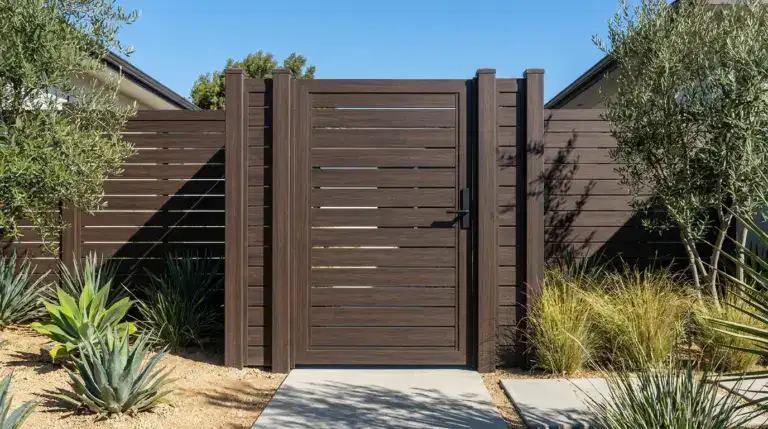
- Composite gives you full privacy with a warmer, wood-inspired architectural look.
- Gates, height, color, slope, access, and hardware can change the final cost for any material.
Your location can influence the decision too. Homes in Woodland Hills, the San Fernando Valley, Riverside, or San Bernardino may deal with stronger heat and sun, while properties near Malibu, coastal Orange County, and Ventura face different exposure around coatings and hardware. HOA requirements, pool barriers, front-yard rules, and wildfire conditions may affect what works for the property. Calcoast Fencing installs vinyl, aluminum, and composite fencing across Southern California. This guide compares cost, maintenance, lifespan, privacy, appearance, gates, and local conditions so you can narrow down which material fits your home and project goals.
How Does a Vinyl vs Aluminum vs Composite Fence Compare?
A vinyl vs aluminum vs composite fence comparison becomes much easier when you focus on five things buyers actually care about. Calcoast Fencing installs all three across Southern California, so the right material depends on price, upkeep, privacy, appearance, and gate needs. Here is the short version.
- Vinyl usually gives the best value for full privacy
- Aluminum usually works best for large gates and open designs
- Composite usually fits premium privacy projects
- Aluminum has the strongest long-term lifespan potential
- Vinyl usually requires the simplest routine care
Which Fence Material Costs Less?
Vinyl fences usually costs less for a standard six-foot privacy fence. Composite tends to cost more, and solid aluminum privacy can reach a similar or higher price range. Open aluminum fencing should be compared separately since it uses much less material than a solid privacy system.
Calcoast’s Southern California research uses planning ranges of about $45 to $85 per linear foot for standard vinyl privacy, $75 to $140 for composite, and $80 to $150 for custom aluminum privacy. These are comparison ranges, not Calcoast quotes.
What Can Change the Final Fence Cost?
The material is only part of the quote. A project can cost more once the property adds larger gates, demolition, steep grades, custom colors, difficult access, or automation.
For example, a 120-foot vinyl privacy fence with one walk gate can cost far less than the same footage in composite with a large automated driveway gate.
Which Fence Needs the Least Maintenance?
Vinyl usually gives homeowners the simplest maintenance routine. Most care involves washing the surface and checking gates, hinges, posts, and hardware.
Fixed aluminum fencing needs little routine care too. Once you add an automated gate, maintenance increases since rollers, hinges, operators, sensors, and access controls need periodic service.
Composite stays relatively easy to maintain, though the boards and aluminum frame still need cleaning and inspection.
Best Low Maintenance Fence by Use
- Backyard privacy usually favors vinyl
- Fixed front-yard fencing can favor aluminum
- Premium privacy can favor composite
- Automated entrances favor aluminum, with more mechanical upkeep
Which Fence Material Lasts the Longest?
Aluminum gates have the highest lifespan potential of the three. Calcoast’s planning research uses about 30 to 50-plus years for aluminum, 25 to 40-plus years for vinyl, and 25 to 40 years for composite. Those figures are planning estimates rather than guaranteed service lives.
Vinyl can last for decades with good posts, reinforcement, and UV-stabilized material. Composite can last for decades too, yet the exact board formulation and frame system matter more.
What Usually Shortens Fence Lifespan?
Impact damage, poor post installation, gate stress, hardware failure, strong exposure, and unavailable replacement parts can shorten the useful life of any fence.
That is why lifespan should be compared by complete system, not by panel material alone.
Which Fence Material Gives the Most Privacy?
Vinyl and composite make full privacy easy. Both can create solid fence runs with very limited sightlines.
Aluminum gives homeowners more choices. Open aluminum provides little privacy, semi-private styles reduce visibility, and solid aluminum systems can provide full screening.
Privacy Comparison at a Glance
- Solid vinyl gives high privacy
- Composite gives high privacy
- Open aluminum gives low privacy
- Semi-private aluminum gives moderate privacy
- Solid aluminum can give high privacy
Vinyl usually makes the most sense for long privacy runs where cost matters. Composite makes more sense where the fence stays visible from a patio, pool, or entertaining area.
Which Fence Material Looks Best?
Vinyl gives a clean and consistent appearance. Aluminum fits modern front yards, open fencing, and custom entrances. Composite gives the closest wood-inspired look of the three.
A homeowner may prefer vinyl for 100 feet of rear-yard privacy, then choose composite for a shorter patio section that stays in view every day. That type of mixed-material plan can control cost without giving up the look you want.
Compare the Materials at Your Property
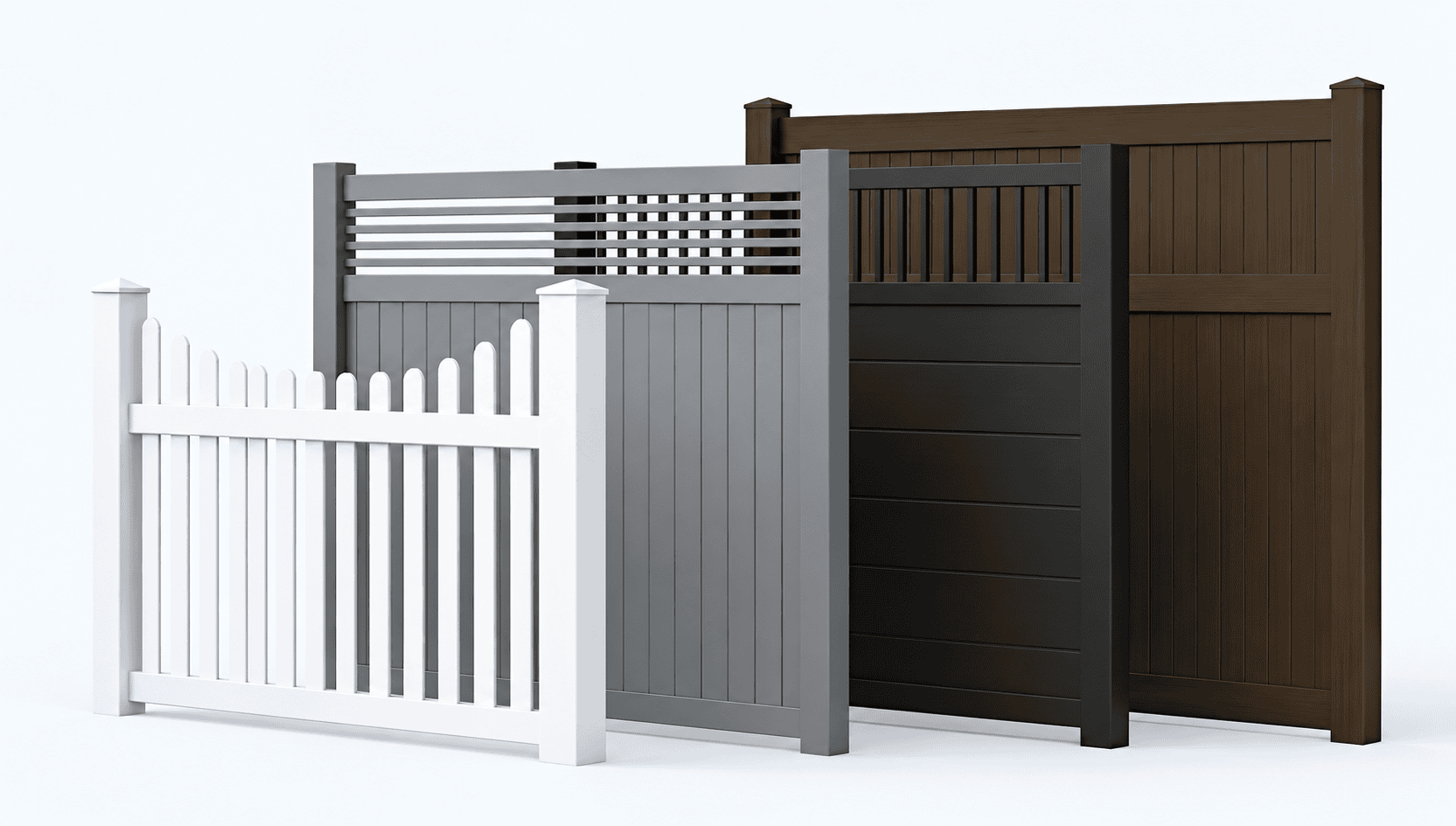
Photos can make colors and textures look different from real life. Calcoast Fencing’s mobile showroom lets homeowners compare vinyl, aluminum, and composite samples next to the actual home. That makes it easier to judge color, texture, privacy, and how each material fits the architecture before making a final choice.
Which Fence Material Works Best for Gates?
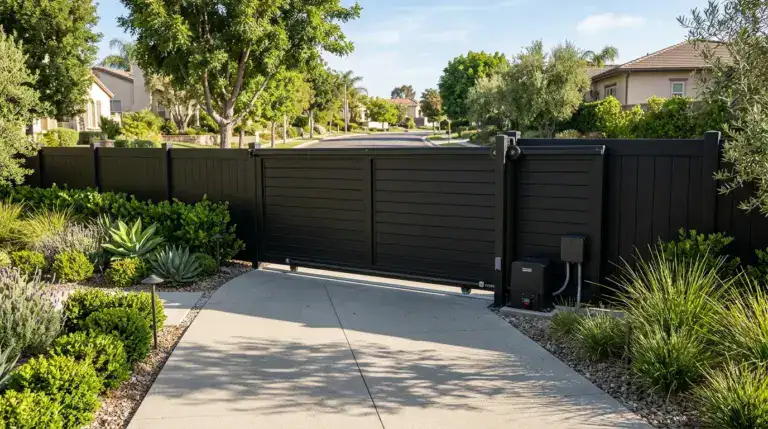
For large driveway gates, sliding systems, and automation, aluminum usually gives the strongest fit. It provides a rigid frame without the weight of many steel systems and works well with operators, rollers, hinges, and access controls.
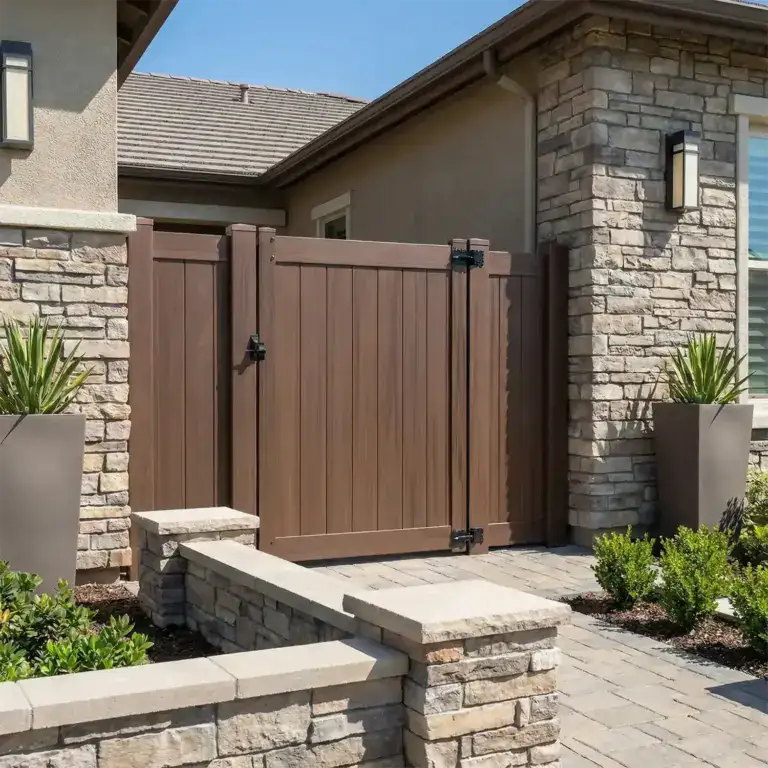
Vinyl works well for walk gates and smaller residential openings. Composite gates usually use a structural metal frame with matching composite boards as the visible infill.
Simple Gate Guide
- Standard walk gate can use vinyl
- Large driveway gate usually favors aluminum
- Automated sliding gate usually favors aluminum
- Composite gate works best with a metal frame
- High-use entrances need serviceable hardware
For most homeowners, the comparison comes down to a simple pattern. Choose vinyl for affordable privacy and easy care. Choose aluminum for gates, open designs, and long-term durability. Choose composite when privacy and a richer architectural appearance matter more than getting the lowest starting price.
Which Fence Material Works Best in Southern California?
Southern California can put very different demands on the same fence. Inland heat, marine air, wildfire exposure, and strong canyon winds each change the material decision. Calcoast Fencing installs vinyl, aluminum, and composite systems, so the better choice starts with what the property faces every day.
For a vinyl vs aluminum vs composite fence, there is no need to guess. Vinyl is often the stronger value for large privacy runs. Aluminum has an edge for gates, open designs, windy locations, and areas near structures. Composite makes more sense where privacy and a premium wood-inspired appearance carry greater weight. Calcoast’s own material research follows the same use-case pattern.
Which Fence Works Best in Inland Heat?
For full backyard privacy in hot inland areas, vinyl is often the practical choice. For driveway gates and modern front yards, aluminum has the advantage. Composite fits homeowners who place more value on architectural appearance and still want a solid privacy barrier.
The climate difference is real. National Weather Service Los Angeles climate research found that July daily highs at LAX averaged about 20 degrees cooler than Canoga Park, and extreme summer patterns can create much larger beach-to-valley temperature gaps.
Vinyl Works Well for Hot Privacy Yards
Vinyl fits places such as Woodland Hills, Northridge, Canoga Park, Riverside, and inland San Bernardino when the main goal is full privacy. Quality vinyl uses UV stabilization, and lighter colors tend to make sense for long runs exposed to intense afternoon sun.
The installation matters just as much as the profile. PVC moves as temperatures change, so rails, posts, and gate frames need the right spacing and reinforcement. Calcoast’s research flags UV exposure, thermal movement, impact, posts, and footings as the main areas to watch with vinyl.
For a homeowner replacing 120 feet of backyard fencing, vinyl may offer a better balance of privacy and project cost than composite. If the same project includes a large automated driveway gate, aluminum may make more sense at the gate opening.
Aluminum Fits Hot Gates and Front Yards
Aluminum works well in strong sun, especially for gates and open fencing. Dark metal can become hot to the touch, so finish and placement still matter.
Its bigger advantage appears at wide openings. Sliding gates, swing gates, and automated entrances place repeated loads on the frame, hinges, rollers, and operator. Aluminum gives the fabricator a rigid metal frame without making the gate excessively heavy.
For a modern front yard in Sherman Oaks, Studio City, or Encino, aluminum can give you open sightlines or semi-privacy without turning the entire frontage into a solid wall.
Composite Fits Design-Focused Privacy Projects
Composite works best in inland heat when the homeowner wants solid privacy and places high value on appearance. Calcoast’s WPC system uses composite boards inside aluminum framing, which creates a different look from standard vinyl privacy fencing.
A contemporary patio in Pasadena or Encino is a good example. Composite can create a warmer backdrop around an outdoor living space, yet vinyl may make more financial sense for less visible side-yard fencing.
Which Fence Works Best Near the Coast?
For coastal views and driveway gates, aluminum is usually the stronger choice. For full backyard privacy, vinyl often gives the simplest low-care option. Composite fits higher-end privacy areas where appearance justifies the added cost.
Malibu, Santa Monica, Rancho Palos Verdes, coastal Orange County, and Ventura bring salt, marine moisture, and exposed hardware into the material decision.
Aluminum Works Best for Views and Gates
Aluminum does not form red rust like ordinary carbon steel, which makes it attractive near the coast. Still, a completed gate can contain steel brackets, bearings, hinges, fasteners, operator parts, and reinforcement.
That distinction matters. A Malibu homeowner should ask what protects the entire gate system, not just what metal appears on the outside. Calcoast’s research identifies fasteners, steel parts, operator enclosures, and dissimilar-metal connections as key coastal concerns.
Open aluminum has another advantage near the coast. It can define the property without blocking ocean, canyon, or hillside views.
Vinyl Gives Coastal Homes Simple Privacy
Vinyl is a strong choice for coastal side yards and backyards where screening matters more than preserving a view. The panels do not need painting or staining, and salt residue can usually be handled with routine washing.
Hardware still deserves attention. A vinyl gate may use metal hinges, screws, latches, or internal reinforcement, so the whole system still needs suitable components for coastal exposure.
For a Santa Monica home with close neighbors, vinyl may offer more practical value than open aluminum. For a view-facing front yard, the decision may flip in favor of aluminum.
Composite Fits Premium Coastal Privacy
Composite works well where the fence becomes part of the home’s architecture. A modern coastal patio, pool area, or outdoor dining space may benefit from the richer texture and solid screening.
The aluminum frame and gate hardware still face marine exposure. Buyers should compare board care, frame finish, fasteners, and hardware before selecting a coastal composite system.
Which Fence Works Best in Wildfire Areas?
Aluminum is the clearest choice near a house or other structure when noncombustible material is a priority. Vinyl and WPC composite fit better farther from structures, subject to the rules that apply to the property.
California Board of Forestry Zone 0 work focuses on the first five feet around structures. As of September 2026, the Board of Forestry states that the final regulation package remains under review.
Aluminum Has the Advantage Near Structures
Aluminum is a noncombustible metal. That gives it a clear material advantage for side gates, short fence sections, driveway entrances, and other areas close to buildings.
A foothill property does not need one material around the whole lot. A homeowner could use aluminum near the house, then transition to vinyl farther down the property line for economical privacy.
This type of mixed-material plan can make sense in Pasadena foothills, La Cañada Flintridge, Ventura County, and other fire-prone communities.
Vinyl and Composite Fit Privacy Areas Farther Away
Vinyl contains polymer. WPC composite contains plastic and wood fiber. Neither should be presented as the same type of fire choice as aluminum.
Their role can shift farther into the property. Vinyl may serve a long rear boundary where privacy and budget lead the decision. Composite may fit an outdoor living area where privacy and appearance carry more weight.
Property owners should confirm current fire requirements before finalizing material placement near a structure.
Which Fence Works Best in Windy Areas?
Open aluminum usually has the advantage on highly exposed properties since air can move through the fence. Solid vinyl, composite, and aluminum privacy systems can still work, but their posts and footings carry much greater wind pressure.
This becomes relevant in Porter Ranch, Tujunga, canyon neighborhoods, hillside lots, and exposed corners.
Open Aluminum Reduces the Solid Wind Surface
An open picket fence does not catch wind like a six-foot solid privacy panel. For a hillside frontage with a view, aluminum can solve two problems at once by preserving sightlines and reducing the amount of solid surface exposed to wind.
Solid fencing calls for a different plan. Vinyl, composite, and solid aluminum privacy systems need post depth, footing size, and spacing that match the site.
ASTM F964 is a useful example of why this distinction matters. The standard covers PVC profile quality, yet it does not establish wind-load capacity for the completed fence assembly. Calcoast’s research makes the same distinction between material quality and installed-system performance.
Which Material Fits Each Southern California Condition?
For a quick comparison, these are the strongest starting points.
- Hot inland backyard with full privacy needs
Vinyl - Hot property with a large driveway gate
Aluminum - Premium modern privacy area
Composite - Coastal property with views
Open aluminum - Coastal backyard needing full screening
Vinyl - High-end coastal privacy area
Composite - Fence section near a structure in a fire-prone area
Aluminum - Windy hillside or canyon frontage
Open aluminum - Long privacy run where project cost matters
Vinyl - Automated driveway entrance
Aluminum
Many Southern California homes benefit from mixing materials. Aluminum can handle the driveway and exposed areas, vinyl can cover long privacy runs, and composite can frame the outdoor spaces where design matters most.
What Should You Check Before Choosing a Fence Material?
Once you narrow the choice to vinyl, aluminum, or composite, the next step is to make sure the project fits the property. Calcoast Fencing can help with measurements, gate layout, material samples, and site conditions during the estimate. That helps turn a general fence idea into a realistic plan before materials get ordered.
Measure the Fence and Gate Areas First
Total linear footage affects price, but gate openings and layout can matter just as much. A good site review should confirm the fence runs, planned height, gate widths, slope, existing walls, and access for installation.
Pay close attention to
- Total fence footage
- Walk gate width
- Driveway gate width
- Sliding or swing gate space
- Uneven ground
- Existing walls or old fencing
- Removal and access needs
Large Gates Need Separate Planning
A driveway gate needs room to open or slide. A sliding gate may need clear space beside the driveway, and a swing gate needs enough room to move without hitting parked cars, walls, or grade changes.
That can affect the material choice too. A property may use vinyl or composite for privacy, then use aluminum for a large automated entrance.
Check Fence Height and Property Rules
Do not choose a six-foot privacy design before checking where it will go. In unincorporated Los Angeles County, fences within a required front-yard setback are typically limited to 42 inches, while standard interior side and rear-yard fences can reach six feet. Some properties have extra restrictions.
Cities and HOAs can set different rules, so check
- Allowed fence height
- Front-yard placement
- HOA-approved materials
- Approved colors and styles
- Pool barrier requirements
- Corner-lot visibility rules
Underground Utilities Matter Before Post Digging
Fence posts require excavation. California DigAlert says excavators must provide at least two working days of notice, excluding the notification date, before digging with powered equipment or when a permit is required.
That means utility marking should be part of the installation plan, not something discovered after crews arrive.
Compare Real Material Samples Before Choosing
Photos can help narrow the style, but real samples give a much better sense of color, texture, and scale. Gray vinyl, dark aluminum, and wood-look composite can appear very different next to stucco, stone, concrete, or landscaping.
When comparing samples, focus on
- Color next to the house
- Privacy level
- Surface texture
- Gate style
- How the finish looks in direct sun
- How the material fits the home’s architecture
Narrow the Choice Before the Estimate Ends
You do not need to compare every fence style available. Start with the main goal.
- Full privacy usually narrows the choice to vinyl or composite
- Large automated gates usually point to aluminum
- Modern open front yards usually favor aluminum
- Long privacy runs often favor vinyl
- High-visibility privacy areas often favor composite
That keeps the decision simple and makes the final quote easier to compare.
Compare Fence Materials With Calcoast Fencing at Your Property
Choosing between vinyl, aluminum, and composite is much easier when you can compare the materials at your own home. Calcoast Fencing can bring the mobile showroom to your property so you can see real vinyl, aluminum, and composite samples next to your exterior, landscaping, gates, and outdoor spaces.
During the visit, you can compare colors, textures, privacy levels, and gate options in person. Calcoast Fencing can measure the project, review the layout, discuss which materials fit your goals, and answer questions about cost, maintenance, lifespan, and design. The consultation and estimate are free, so you can get a clearer idea of the project before making a decision.
If you are ready to compare fence materials at your property, contact us or call (833) 986-8877 to schedule your free estimate and mobile showroom visit.
Ready To Secure Your Property ?
Work with a team that values safety, quality, and professionalism as much as you do.