Blog
Table of Content
Table of Content
- California Fence Laws & Property Line Rules: A Homeowner’s Guide (2026)
- Who owns a fence on the property line in California?
- How close to the property line can you build a fence?
- Can I remove a neighbor’s fence on my property in California?
- Do I have to give my neighbor the “good side” of the fence?
- What are my options if a neighbor attaches things to my fence?
- Spite fences and fence height limits
- California’s spite fence law (Civil Code § 841.4)
- Los Angeles fence height limits
- Do you need a permit for a fence in Los Angeles?





California Fence Laws & Property Line Rules: A Homeowner’s Guide (2026)

David A.
David is the Inspection Manager at CalCoast Fencing. He reviews fence and gate project details and helps the team identify site conditions that may affect installation.
California Fence Laws & Property Line Rules: A Homeowner’s Guide (2026)
Picture this: you step into your backyard, ready to enjoy a quiet morning. Instead, you end up staring at a sagging, weathered wooden fence that looks like it might collapse if a strong wind blows through. You want to replace it. Or maybe you want to build a brand-new one. But then the questions start piling up. Where exactly does your property end and theirs begin? Who pays for the new build? Can you just tear down the old one without informing them?
If you are a homeowner in California, navigating these questions can feel like walking through a legal maze. One wrong step could lead to thousands of dollars in wasted materials, a mandatory teardown order, or even worse, an ongoing, exhausting feud with the person living next door.
The good news is that California has very specific, clear laws that lay out exactly what you can and cannot do. From shared expenses to height limits and permit requirements in major cities like Los Angeles, we have got you covered. This guide breaks down the laws into simple, actionable steps so you can plan your project with confidence, and keep the peace in your neighborhood.
Who owns a fence on the property line in California?
If a fence sits directly on the boundary line between your lot and your neighbor’s lot, neither of you can claim sole ownership. Under state law, this is considered a shared structure. This means both of you are co-owners of the fence, regardless of who originally paid to install it.
This shared ownership brings shared responsibilities. California handles this through a very specific piece of legislation known as the Good Neighbor Fence Act of 2013, which is coded under Civil Code § 841. The law states that adjacent landowners are equally responsible for maintaining, repairing, or replacing a boundary line fence.
In practice, this means the financial burden of keeping that fence standing is split 50/50. If the fence starts to rot, lean, or fall apart, both parties must contribute to the fix. However, this does not mean you can simply hire a contractor, rebuild the fence, and hand your neighbor a surprise bill for half the cost. To trigger this shared fence responsibility, you have to follow a strict legal process, starting with a formal written notice before any work begins.
Do I need my neighbor’s permission to build or replace a fence?
The short answer is no, you do not technically need their permission to build on your own property. However, if you want to build right on the boundary line and expect them to pay for half of it, you absolutely must notify them.
The Good Neighbor Fence Act requires you to give your neighbor at least 30 days’ written notice before you start any construction or replacement work on a shared boundary. This notice cannot be a casual text message or a verbal mention over the driveway. It must be a physical letter that includes:
- A detailed description of the problem with the current fence.
- Your proposed solution, such as replacing it with a new fence.
- The estimated cost of the project and how those costs will be shared.
- The proposed timeline for the construction.
If you skip this step and replace the fence anyway, you lose your legal right to demand contribution. Your neighbor could refuse to pay, and the court would likely side with them because you did not follow the proper procedure.
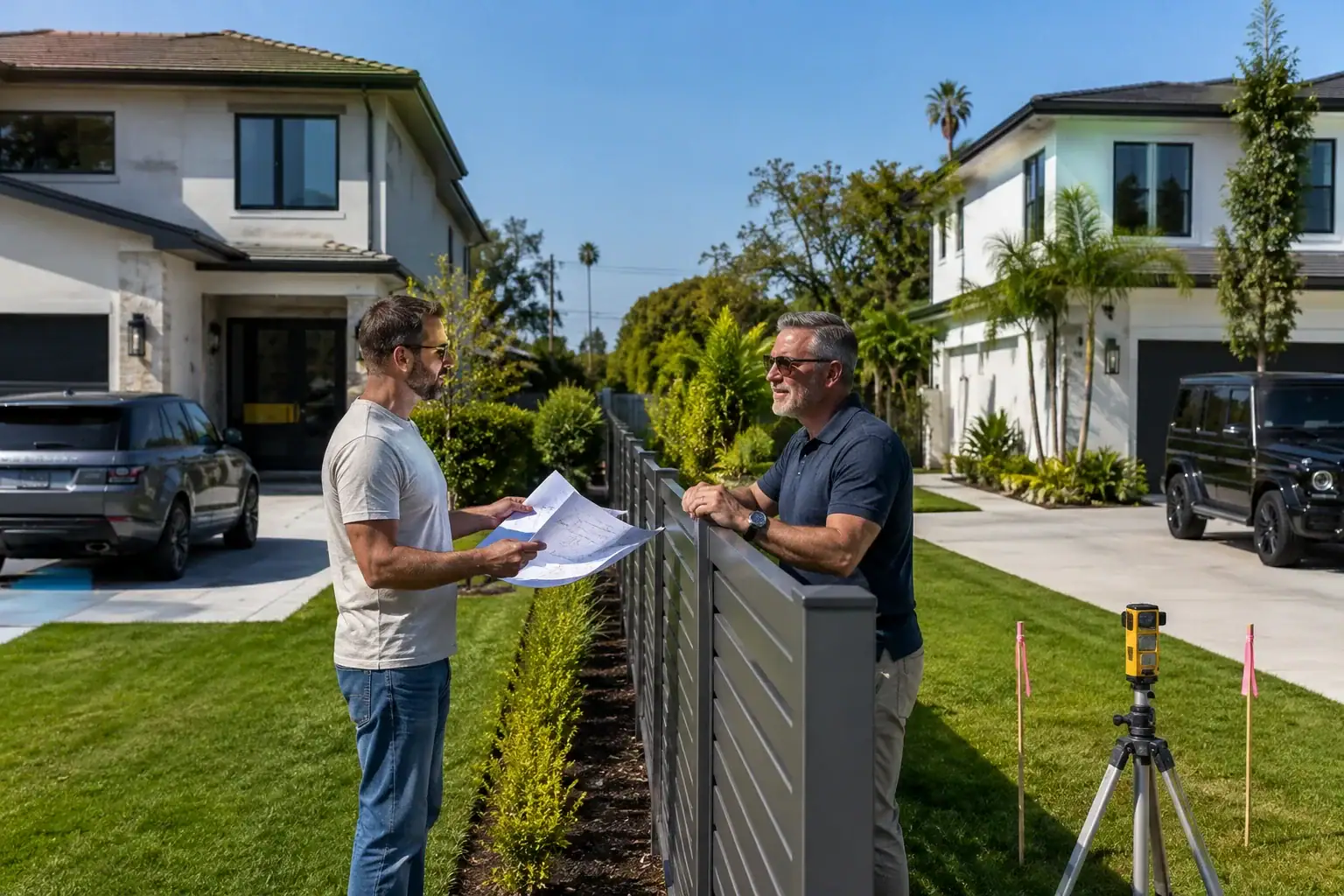
If you plan to build a new fence entirely inside your own property line, you do not need their permission or contribution. However, keeping them in the loop is still the smartest move. If you want to learn more about starting these conversations and managing the logistics smoothly, check out our practical guide on how fencing works with neighbors to keep your project stress-free.
How close to the property line can you build a fence?
One of the most common myths among homeowners is that you have to set your fence back several inches or feet from your actual boundary. In California, you can build a fence directly on the property line.
However, it requires absolute precision. If even a fraction of an inch of your new fence crosses over the boundary line, it is legally considered an encroachment.
If you build a fence and later find out it sits on your neighbor’s land, they have the legal right to demand its removal. This can lead to incredibly tense disputes, expensive court battles, and the eventual cost of tearing down and rebuilding your fence.
To avoid these problems, never rely on old, hand-drawn maps, online satellite views, or assumptions. The only way to be 100% sure of your boundaries is to hire a licensed contractor that will help you to define your exact property line.
Can I remove a neighbor’s fence on my property in California?
Discovering that your neighbor’s fence actually sits on your side of the property line is incredibly frustrating. Your immediate reaction might be to call a contractor right away or demand that it be moved. Before you take any quick steps, it is best to pause for a moment.
Tearing down or altering a fence yourself, even if you are completely certain it encroaches on your land, comes with serious risks. Under California law, taking immediate, unilateral action to remove property is considered self help. If you remove the structure without their consent or an official court order, you could accidentally open yourself up to legal issues regarding property damage or trespass.
Instead, you must handle the situation systematically:
- Get a professional survey: Prove the encroachment with an official, stamped survey map.
- Talk to your neighbor: Show them the survey results. They might have honestly had no idea where the line was and may agree to move it willingly.
- Draft a boundary agreement: If you do not mind the fence being slightly over the line, you can sign a written agreement allowing it to stay temporarily without granting them permanent rights to your land.
- Seek legal mediation: If they refuse to cooperate, your next step is a formal demand letter from a lawyer to obtain a removal order.
Keeping things calm and legal always saves you time and money in the long run.
Do I have to give my neighbor the “good side” of the fence?
If you are funding the entire project yourself, you might wonder about the layout. Do you have to place the finished, smooth side facing your neighbor and keep the side with the visible structural posts and rails for your own view?
Legally, there is no statewide California law that forces you to give your neighbor the “good side.” However, many local city ordinances and Homeowners Associations (HOAs) do have strict rules about this. In many municipalities, the law requires the finished, attractive side of the fence to face outward toward the public street and adjacent properties.
Beyond local codes, putting the good side out is also a matter of standard building etiquette. Leaving the structural posts exposed to the outside can make your property look unappealing from the street, and it might even make it easier for intruders to climb over.
Fortunately, modern materials have completely solved this old dilemma. You no longer have to choose who gets the raw end of the deal. For example, our vinyl privacy fences feature a smart, double sided design. Both sides of the fence look absolutely identical, clean, and finished. This means both you and your neighbor get a gorgeous, clean view, eliminating any arguments about who gets the “good side.”
What are my options if a neighbor attaches things to my fence?
You spent weeks planning and thousands of dollars building a neat, clean fence on your property. A few days later, you see your neighbor has nailed heavy planter boxes, strung up heavy holiday lights, or allowed thick, invasive vines to grow directly over your panels. What can you do?
Because the fence belongs to you (or is a shared structure that you both must maintain) your neighbor cannot make modifications or attach items to it without your permission.
If this happens, you have several clear, practical options to solve the issue:
- Initiate a conversation: Explain your concerns focusing on the structural integrity of the fence. Let them know that the extra weight or moisture could ruin the panels and force an early, expensive replacement.
- Send a written request: If a friendly chat does not work, write a polite letter asking them to remove the items. Mention that you want to avoid damage to the shared or personal property.
- Suggest independent alternatives: Point them toward freestanding garden trellises or posts that they can install on their own side of the line without touching your fence structure.
- Review local HOA rules: If you live in an HOA controlled neighborhood, report the issue. HOAs almost always have strict rules against attaching personal items to shared structures.
Spite fences and fence height limits
While fences are designed to provide privacy and security, they are sometimes used as tools of frustration. In California, building an excessively tall or ugly structure purely to annoy, block the view of, or harass a neighbor is illegal.
State and local laws work together to prevent these situations, setting clear limits on how tall structures can be and how they can be used.
California’s spite fence law (Civil Code § 841.4)
Under California Civil Code § 841.4, any fence or fence-like structure, including rows of thick trees or hedges, that unnecessarily exceeds 10 feet in height and is built or maintained maliciously to annoy a neighbor is legally defined as a “spite fence” and a private nuisance. If a court rules a structure is a spite fence, the owner will be legally forced to tear it down or lower it.
Los Angeles fence height limits
Even if there is no malicious intent, you still cannot build your fence as high as you want. Local zoning codes set strict boundaries. For example, the Los Angeles fence height limit for residential properties generally restricts front yard fences to a maximum of 3.5 feet (42 inches). Side and rear yard fences can usually be up to 6 feet tall, and in some specific residential zones, up to 8 feet with certain lot width conditions.
Additionally, if you are building around a pool, safety is the primary legal driver. California has incredibly strict pool safety laws. If your fence project serves as a safety barrier for a swimming pool, make sure to cross reference our detailed pool fencing guide to ensure your height, gate latches, and clearances meet every single state safety standard.
Do you need a permit for a fence in Los Angeles?
Before you buy your fence materials or hire a crew, you must determine if your project requires an official building permit. Building a fence without a permit can result in heavy fines from the city and a mandatory order to stop work or demolish what you have built.
In the city of Los Angeles, the guidelines set by the Los Angeles Department of Building and Safety (LADBS) are quite clear:
- No Permit Needed: You generally do not need a permit for standard wood, vinyl, or light metal fences that are 6 feet or less.
- Permit Required: You need a permit if your fence will be over 6 feet tall, if it is a masonry wall over 3.5 feet tall, or if it acts as a retaining wall holding back soil.
Even if you do not need a permit, your fence must still comply with all local zoning and height rules. Navigating these codes and paperwork can feel overwhelming, but working with the right team changes everything.
A professional builder does not just install the panels.They provide complete guidance through the entire process. This includes taking care of all technical details by designing custom fences with permit ready plans that meet every structural standard.
FAQ
Who is responsible for a shared fence in California?
Adjacent homeowners share equal responsibility for the care, repair, and replacement costs of any fence on their shared boundary line. Both parties must split the costs 50/50.
Do I need my neighbor’s permission to replace a fence?
You do not need their permission, but if you expect them to pay for half of a shared fence, you must provide them with a written 30 day notice with the costs, design, and timeline before starting any work.
Can I remove a neighbor’s fence that’s on my property?
No, you should never tear down an encroaching fence yourself, as this can lead to legal issues. Instead, verify the boundary line with a land survey and use legal channels to have it removed.
How close to the property line can I build a fence in California?
You can build a fence directly on your property line. However, to avoid legal disputes and costly encroachments, you must ensure that no part of the fence crosses over the boundary.
Do I have to give my neighbor the good side of the fence?
While state law does not mandate this, many local city codes and HOAs require the finished, smooth side of the fence to face outward toward public areas and neighbors.
How tall can a fence be in Los Angeles without a permit?
In Los Angeles, you can build a vinyl, wood, or metal fence up to 6 feet tall without a building permit, provided it complies with local front and side yard zoning height limits. Masonry walls over 3.5 feet always require a permit.
Disclaimer: The information provided in this article is for general informational purposes only and does not constitute formal legal advice. Fence laws, zoning ordinances, and permit requirements vary by city, county, and individual Homeowners Associations (HOAs). Always consult with a licensed attorney, a professional land surveyor, or your local municipal building department before starting any construction project.
Related Services
Ready To Secure Your Property ?
Work with a team that values safety, quality, and professionalism as much as you do.